April 11, 2005

"Houston, we've had a problem"

Being born in the last days of 1970, I missed all the good stuff.

Today is the 35th anniversary of the launch of Apollo 13. What was supposed to be the third moon mission turned into a gripping drama when bad wiring caused an oxygen tank in the service module to explode, crippling the spacecraft's ability to generate electricity. Without power, the command module became uninhabitable, and astronauts James Lovell, Jack Swigert, and Fred Haise were forced to use the lunar module as a "lifeboat" - hoping that a craft intended to keep two men alive for two days would keep three alive for four. Thanks to the leadership of flight director Gene Kranz and the support of astronaut Ken Mattingly (who was replaced by Swigert on the flight crew) in the simulator, Apollo 13 returned to earth safely, except for an infection that Haise contracted because of lack of potable water.

Modifications were made to subsequent spacecraft to prevent the same accident from happening again, and NASA made four more successful landings on the moon. As of now, however, it has been 32 years and four months since man stood on the surface of another world.

April 10, 2005

There oughta be a law against this

By the time you read this, I'll be listening to "Brother Stair" on the shortwave and reading H. P. Lovecraft until I pass out on top of the book.

A dangerous combination, especially for a guy who once got seriously creeped out by falling asleep listening to Dark Side of the Moon, a few moments before all the bells went off . . .

April 09, 2005

Mr. Kettle? Mr. Pot on line 3

Jerry Jenkins and Tim LaHaye, whose “Left Behind” series made end-times theology a nationwide topic of discussion, have expressed wariness of NBC's apocalyptic mini-series "Revelations," which premieres April 13.

One of the series’ main characters, “Dr. Richard Massey,” a skeptic Harvard professor played by Bill Pullman, looks as though he is headed toward becoming “a firm believer,” as Jenkins put it, during the course of the six-hour series.

A Bible epic on network television? Mishandled? Say it ain't so!

But, said Jenkins, who has viewed the first Revelations episode, “[W]hat he promises to come to believe is a mishmash of myth, silliness, and misrepresentations of Scripture.

"Myth, silliness, and misrepresentations of Scripture"? Careful, Jerry, you know what they say about your other fingers when you point one.

"Acknowledging that not everyone agrees with my particular take on end-time prophecies, at least they are based on some commonly accepted study,” Jenkins said. “Revelations seems to draw from everywhere and nowhere."

[Full Story

Being "based on some commonly accepted study" didn't stop Jenkins' co-author from lashing out when Hank Hanegraaff's preterism-inspired The Last Disciple came off the press. One wonders whether this outburst of sour grapes is inspired by some more basic motive. Oh, say . . . jealousy.

(H/T: Quadrivium.)

And so the freakshow begins

This morning as I woke up I was listening to "Brother" R. G. Stair, the wingnut "Last Day Prophet of God" from Walterboro, South Carolina who will believe anything as long as someone claims it is a divine revelation.

Today the King of Credulity has picked up on the supposed "prophecies" of one St. Malachy, a 12th-century Irish bishop and mystic. He is best known for "The Prophecy of the Popes," a list of 112 Latin aphorisms purported to be descriptive of the future popes of Rome. In this respect St. Malachy is sort of a Catholic Nostradamus, in that every time a pope dies, people bend themselves over backwards trying to fit the Latin phrase in some way to its supposed respective pontificate. At least one pope has manipulated events so that his own "prophecy" would be fulfilled, and the connection between the "prophecy" and corresponding events are often so tenuous as to be highly questionable. (Like Nostradamus.)

The "prophecy" for pope #110, John Paul II, reads: De labore Solis, and can be translated "Of the eclipse of the sun." Stair notes that a solar eclipse occurred on May 18, 1920, the day Karol Wojtyla was born, and also on April 8, 2005, the day of his funeral. (No unusual solar activity occurred on April 2, the day of his death; hence Stair and others are guilty of specious, selective reasoning.)

Of course, there are only two more popes on the list, and the last is the supposed "Peter the Roman," during whose pontificate the city of Rome is to be destroyed and the Final Judgment begin. Since "Profit" Stair has been predicting the end of the world Real Soon Now for years, it's easy to see why this is so interesting to him. What is more interesting to me is why he affords some Catholic mystic so much credence when he has no love for the Church of Rome.

But who expects consistency from the lunatic fringe? My "prophecy" is that Stair will drop St. Malachy when his accuracy turns out to be approximately equal to Stair's ravings about "Planet X" a couple of years ago. Stair doesn't talk about Planet X that much anymore . . .

On the nuptials of His Royal Highness the Prince of Wales and Mrs. Camilla Parker Bowles

Yawn.

I saw him married the first time.

Update: I captured a few images from CNN immediately after the wedding, just for fun (didn't watch the whole thing). Frankly, the new Duchess of Cornwall, at least when dressed formally, isn't half the frump the press makes her out to be:

[HRH the Prince of Wales and the Duchess of Cornwall]

Car envy update: This is the Queen's 2002 Bentley limousine, literally one of a kind. Nice car:

[Royal Bentley State Limousine]

And this is the 1975 Phantom VI, also part of the royal motor pool, used by the wedding couple. Also a nice set of wheels, but if I had the money to throw around, I think I prefer Bentleys. The colour of each, incidentally, is "Royal claret":

[Royal Rolls Royce Phantom VI State Limousine]

April 07, 2005

Am I your enemy for telling the truth?

Apropos to my Sacra Eloquia post today on Galatians 4:8-20, La Shawn Barber shares some of the "dislike" mail she received (keeping the hate mail to herself) after blogging an unpopular opinion about the pope.

I hope she doesn't get the kind of thing Michelle Malkin has to put up with on a regular basis.

April 06, 2005

Mushy-headed evangelicals and the passing of the Pope

I must give credit where credit is due. Karol Wojtyla, aka Pope John Paul II, was a great man.

The late pope has stood against the two greatest threats to human freedom in the last 100 years - Nazism and Communism - and prevailed. His pontificate was marked by his activities as a bridge-builder: reaching out to Jews, to Muslims, even to Protestants, getting people to talk to each other instead of throwing things. He stared down dictators and democrats, leftists and rightists. He was more deserving of the Nobel Peace Prize than half the people who received one during his pontificate. John Paul was a statesman. I do not grudge him that.

John Paul II embodied the moral life of the Gospel: visiting his would-be assassin in prison, acknowledging for the first time that the Crusades were a Bad Idea, that the Roman church could have done more to help the Jews while they were being slaughtered by Hitler's cronies. He forgave and he sought forgiveness. The most travelled pope in history, his public image was one of a shepherd of the church rather than a bureaucrat. He opposed the excesses of capitalism and totalitarianism both. The encyclical Evangelium Vitae brought a wonderful phrase, "culture of life," into the popular culture. The pope was a moral anchor in a world gone morally adrift. Where he would stand with the Bible, I would stand with the pope. I do not grudge him that.

The pope mastered 16 languages. He was an actor, an author, a playwright, and a poet. He was a true intellectual. As an athlete he took up mountaineering, football, and skiing. For four years in Nazi-occupied Poland he was a worker in the quarries. John Paul II was a man for all seasons. I do not grudge him that.

To listen to some of the Vatican officials immediately following the pope's death on Saturday, Jesus, Mary, and the holy angels were practically falling all over each other to fling open the Pearly Gates and usher Karol Wojtyla directly into the presence of the throne of God. It wasn't long before evangelical "leaders" such as Pat Robertson (Pentecostal), Billy Graham (Baptist), James Dobson (Nazarene), and, yes, President Bush (Methodist) were doing the same thing.

This is mushy-headed evangelicalism at its finest: effectively, such "leaders" are claiming that the pope got a "free pass" into heaven because of his good deeds, while they simultaneously forget (or ignore) why it is that Pentecostals, Baptists, Nazarenes, and Methodists are not subject to the pope to begin with.

(To be fair, there is indeed a fair amount of mushy-headedness on the other side as well: people who reflexively declare the pope the Antichrist and consign him to the flames of hell for no better reason than that he was a Catholic pope, and they're agin' it.)

The Roman church has a false view of authority. According to Roman dogma, authority comes from three sources: Scripture, Sacred Tradition, and the Church. However, since the Magisterium of the Roman church (comprising all its bishops) claims for itself the authority to define both the extents and meaning of Scripture and Tradition, in reality Rome arrogates to itself the highest authority.

The Roman church has a false view of salvation. Departing from the simple gospel of divine grace through faith in Christ's completed work on the cross, the Church of Rome has established a complicated sacramental system in which believers continually earn justifying grace through meritorious works and partaking in the sacraments. The church claims to have the authority to dispense from the "Treasury of Merit" the superfluous merit of Christ, Mary, and the saints to those in need of it. Thus the Church of Rome presents a weak Christ who is unable to "save to the uttermost" (Heb. 7:25); his atonement must be supplemented by the righteousness of others. While historically Protestant and Catholic stand in agreement against the classical heresies concerning the person of Christ, surely it is no less dangerous to promote heresies that deny or weaken the work of Christ, is it?

The evangelical rejection of the papacy and the Romanism it represents is no trivial matter. It is based on first principles.

Is the pope in heaven now? While I can't make a definite pronouncement one way or the other, I think it's doubtful. Being the leader of a really big church doesn't merit special grace from God, who is no respecter of persons. I am not a mind reader. I can't get into the head of John Paul II and know what he believed in secret. But as the visible head of the Church of Rome, which preached these untruths, did he repudiate them? No, he defended them, and supported and promoted superstitions that are antithetical to the true Gospel, most notably in his devotion to Mary (it has not escaped the attention of the pundits that his death came on the eve of Divine Mercy Sunday, a feast day he himself instituted in honour of the alleged Marian apparitions of Fatima).

This is essentially nothing different than what people like James White or Al Mohler or La Shawn Barber have been saying in the wake of this weekend's events. Ironically, this position is more consistent with proper Catholic orthodoxy than the more frenzied pronouncements that immediately followed John Paul II's death: since no one can know what thoughts went through his head as his demise approached, no one can be certain that he finally escaped purgatory.

And as a result, they too are being vilified, primarily by Catholics. (White has been specially singled out for vitriol.) Mushy-headedness isn't just an evangelical phenomenon.

Hahahahaha!

I just read this over on James White's blog:

And so now what do I find but a listing of my books and their Amazon sales ranks compared to who else, but DA [Dave Armstrong]! Honestly, how utterly pathetic can someone become?

[Read The Most Pathetic Post I've Ever Seen...]

And yes, it is indeed pathetic . . .

Just for fun, I did up the following scientific tally:

  • Number of James White's books I own: 9
  • Number I bought at Amazon: None of them

On the other hand . . .

  • Number of Dave Armstrong books I own: 0
  • Number I bought at Amazon: All of them

There you have it (for whatever it's worth).

April 01, 2005

It was fun while it lasted

But, yeah, for those of you who thought I went off the deep end, no, I haven't converted to KJV-onlyism. (Yet.)

I was originally going for parody, not practical joke. There's a certain tackiness about a good number of fundamentalist Web pages which, fortunately, is easy to whip up in about 15 minutes. (It took me twice as long to figure out the exact shade of orange I currently use for horizontal rules.) Don't let anyone ever tell you that those HTML skills you learned back in 1995 aren't good for anything.

Little was I to know that I was going to actually sucker a couple of my good friends. Sorry Rand and Brandt, nothing personal. And nice try at deconstructing the Creed of the Alexandrian Cult. I can't do it without someone piling on the clichés in retort, either. Rebecca got it right off, and it looks like a bunch of my #pros friends are having a ball. (Hi guys!)

On the downside, Blogger appears to be misbehavin', so it might be a while before those of you reading the archive pages aren't assailed by that hideous MIDI of "In the Garden" . . .

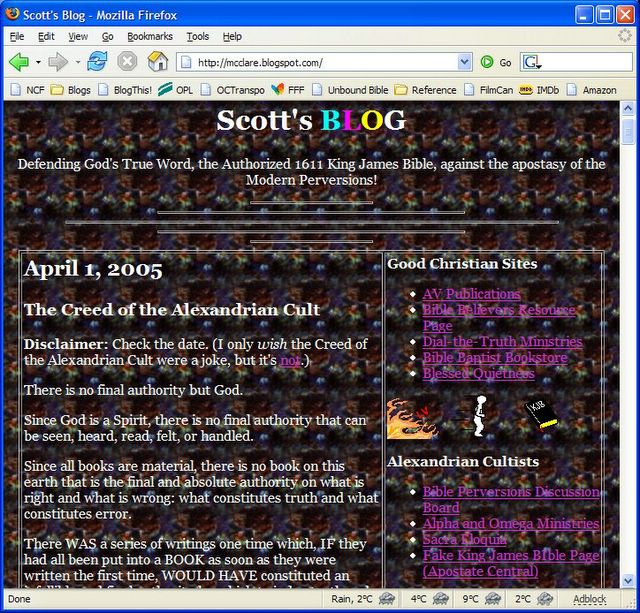
Update (Apr. 2):I got a few messages from people who were a little disappointed they missed the fun. You can now simulate the effect by staring at the following screenshot while listening to this MIDI file.

Don't say I didn't warn you.

The Creed of the Alexandrian Cult

Disclaimer: Check the date. (I only wish the Creed of the Alexandrian Cult were a joke, but it's not.)

There is no final authority but God.

Since God is a Spirit, there is no final authority that can be seen, heard, read, felt, or handled.

Since all books are material, there is no book on this earth that is the final and absolute authority on what is right and what is wrong: what constitutes truth and what constitutes error.

There WAS a series of writings one time which, IF they had all been put into a BOOK as soon as they were written the first time, WOULD HAVE constituted an infallible and final authority by which to judge truth and error.

However, this series of writings was lost, and the God who inspired them was unable to preserve their content through Bible-believing Christians at Antioch (Syria), where the first Bible teachers were (Acts 13:1), and where the first missionary trip originated (Acts 13:1-52), and where the word 'Christian originated (Acts 11:26).

So, God chose to ALMOST preserve them through Gnostics and philosophers from Alexandria, Egypt, even though God called His Son OUT of Egypt (Matthew 2), Jacob OUT of Egypt (Genesis 49), Israel OUT of Egypt (Exodus 15), and Joseph's bones OUT of Egypt (Exodus 13).

So, there are two streams of Bibles: the most accurate (though, of course, there is no final, absolute authority for determining truth and error: it is a matter of "preference") are the Egyptian translations from Alexandria, Egypt, which are "almost the originals," although not quite.

The most inaccurate translations were those that brought about the German Reformation (Luther, Zwingli, Boehier, Zinzendorf, Spener, etc.) and the worldwide missionary movement of the English-speaking people: the Bible that Sunday, Torrey, Moody, Finney, Spurgeon, Whitefleld, Wesley, and Chapman used.

But we can "tolerate these if those who believe in them will tolerate US. After all. Since there is NO ABSOLUTE AND FINAL AUTHORITY that anyone can read, teach, preach. or handle, the whole thing is a matter of "PREFERENCE." You may prefer what you prefer, and we will prefer what we prefer; let us live in peace, and if we cannot agree on anything or everything, let us all agree on one thing: THERE IS NO FINAL, ABSOLUTE, WRITTEN AUTHORITY OF GOD ANYWHERE ON THIS EARTH.