February 08, 2021

And now . . . this - Feb. 8/21

A Louisiana woman has sought medical treatment after mistakenly using Gorilla Glue spray adhesive in place of actual hair spray.

Tessica Brown's plight gained attention earlier in February after she revealed that her hair had been stuck in the same style for a month since she substituted her usual Got2b Glued spray with the industrial-strength glue when she ran out.

[Full Story]

I predict a lawsuit. Though the Gorilla Glue label says not to get it in your eyes, or on your skin or clothing, it doesn't say anything about using the permanent, waterproof, industrial-strength adhesive as a hair fixative.

January 21, 2021

Hey, hey, what do you say, someone took your plans away

A lightning review of Support and Defend by Mark Greaney (New York: Putnam, 2014). Ebook.

Dom Caruso, nephew of President Jack Ryan and employee of the black intelligence agency, The Campus, is injured in a terrorist attack that kills his Israeli martial-arts trainer. The terrorists had learned from a National Security Council data breach that the trainer was a former IDF commando who had raided the Gaza "peace flotilla." The leaker is a rogue employee who is feeding intelligence to an international whistleblower organization. Caruso embarks on an unauthorized mission to catch the rogue and avenge his friend.

This is the first "Ryanverse" novel to be published without Tom Clancy's involvement following his 2013 death. I've been a fan of Clancy since the mid-90s during university. They were a relaxing break from the literary works I had to read for my coursework. Clancy's trademarks were technical accuracy and intricate, interwoven plots. Unfortunately, Mark Greaney's effort has neither: the plot of Support and Defend is linear and shows no evidence of Clancy's research into military technology and tactics. It's set in Clancy's world, but has none of Clancy's flair.

And while this may not be entirely Greaney's fault, did this novel lack an editor? At one point, out of nowhere, Russian paratroopers stage a failed attempt to abduct the NSC rogue. They are all killed and the Russians are never heard from again. This plot point has neither reason nor consequences. Was a subplot rather clumsily removed for length? Formally, I noted several missing, misplaced, and misused words, confused character names, and at one point, an entire paragraph that seemed to have been rewritten without deleting the old one afterward.

Support and Defend isn't terrible. But its numerous flaws make it merely OK.

January 01, 2021

Time for the annual reading in perspective post

A year ago, Kim Shay blogged a reading challenge that was suggested by one of the women in her fitness accountability group, to read 20 books in 2020, in a variety of categories. While I'm not connected to Kim or her group, nor a woman, nor fit, nor accountable, I thought the challenge sounded fun, so in addition to my regular reading, I decided to take it up as well.

Deciding what books to read for each category came fairly easily for the most part, though there was a small quantity where I hadn't made up my mind until well into the year.

  • A Shakespeare play: Henry VI, Part 2. Late in 2019, I made plans to read through all of Shakespeare's plays on weekends, in their (theorized) chronological order, in 2020. I actually started during my Christmas break, reading The Two Gentlemen of Verona, The Taming of the Shrew, and Henry VI, Part 1. Hence Henry VI, Part 2 was my first play of 2020. This is the best of the Henry VI trilogy, and the source of the classic (and oft-misinterpreted) line, "First thing we do, let's kill all the lawyers." (Incidentally, it's thought that Shakespeare wrote the Henry VI trilogy out of order- part 2, 1, then 3. I took the liberty of re-ordering them for my own reading.)
  • A classic detective novel: The Secret Adversary by Agatha Christie. This was Christie's second mystery, following The Mysterious Affair at Styles. It introduced Tommy and Tuppence. husband-and-wife private detectives. Though they're not as well known as Christie's other creations, Hercule Poirot and Miss Marple, she published five novels featuring them. To be fair, I suppose this novel may be as much an espionage thriller as a mystery. But there was plenty of detecting.
  • A classic children's book: The Adventures of Tom Sawyer by Mark Twain. As a youngeter, I had an abridged edition of Tom Sawyer as a youngster, so while I knew all the major plot points, I'd never read the full-length novel. My original choice for this category was Treasure Island (also abridged in the same volume), which I also read this summer, but once I had settled on re-reading Huckleberry Finn (see below), reading the two books back-to-back made perfect sense.
  • A contemporary novel: The Testaments by Margaret Atwood. At one point, I contemplated re-reading The Handmaid's Tale (also assigned during high school) or putting it in the "classic book by a female author" category. Either way, I was going to get to The Testaments, published in 2019. This novel takes place roughly 15 years after the events of The Handmaid's Tale. It takes the form of an epistolary novel, intertwining the testimony (or confession) of three figures: the teenage daughter of a Commander, a teenage girl living as a refugee in Canada, and Aunt Lydia, the principal antagonist of The Handmaid's Tale. Each one tell their story, hinting at the cause of the downfall of the theocratic dictatorship of Gilead. It seems to me an unnecessary sequel (perhaps intended to cash in on the success of the Handmaid's Tale TV series), but I still found it an enjoyable way to pass the time. On the other hand, the big reveals toward the end are underwhelming. Overall it was a worthy read, though I'm not sure if it was a Booker Prize-worthy one.
  • A historical fiction novel: Desolation Island by Patrick O'Brian. This is the fifth book in O'Brian's series of naval adventure novels featuring Captain Jack Aubrey and his surgeon and secret-agent friend Stephen Maturin. I've been reading this series off and on over the past few years. In this novel, "Lucky Jack" receives a new command, the fourth-rated HMS Leopard, and is commanded to transport a group of prisoners to Botany Bay. A battle with a Dutch warship in the middle of the novel is absolutely gripping. The Leopard was a historical ship, though of course Jack Aubrey's command of it was fictional. It was involved in a skirmish with an American ship, resulting in an international incident that was one of the indirect causes of the War of 1812.
  • An ancient Greek play: The Clouds by Aristophanes. I'm sure anyone else taking up Kim's challenge opted for a better-known drama like Oedipus Rex or Lysistrata. On the other hand, I've wanted to read The Clouds ever since reading Plato's Apology in university. Socrates may have believed that his portrayal in The Clouds, in which he is portrayed as a buffoonish swindler, contributed to the charge that he corrupted the youth of Athens, for which he was put to death. As for the play itself, it's nothing special. Apparently it wasn't well received in its own time, either. The popularity of fart jokes is as old as dirt, though.
  • A collection of short stories: The Complete Stories by Flannery O'Connor. I've owned this anthology (originally published in 1970) for years, but never opened it, though my university curriculum included reading "Revelation," "Good Country People," and perhaps also "A Good Man is Hard to Find." in university. O'Connor's writing was wonderful, though her characters are ignorant, nasty, and bigoted. This was by design: she was a devout Catholic, writing about how these grotesque characters encountered divine grace.
  • A biography or memoir: Jack: C. S. Lewis and His Times by George Sayer. This is another book I've owned for years and never read until now. Contrasted with A. N. Wilson's better-known, unflattering Lewis bio of 1990 (published two years later) this biography paints him in a more positive light, without glossing over his faults. Sayer was a student and personal friend. The emphasis is on Lewis' earlier life. It seemed to me that his later years, apart from his marriage to Joy Gresham, were rushed through a bit too hastily. Otherwise, this was a very good book.
  • A devotional work: Morning Exercises by William Jay. Admittedly, I'm terrible at sticking with daily devotions, reading the Bible through in a year, and things like that. But at least this year I read more of Jay's book than I have in past attempts. Jay was an English Congregationalist minister in the late 18th and early 19th centuries. His morning devotions are wonderfully rich; you'd be lucky to get this level of theological depth in a contemporary devotional book.
  • A book about books: What Happens in Hamlet by John Dover Wilson. Wilson was the editor of the New Cambridge Shakespeare series published by Cambridge Univeristy Press in the early 20th century. His opinions on Shakespeare, though held confidently, were frequently controversial. Why, for example, in Hamlets play-within-a-play, is Claudius spooked by the murder scene, but not the pantomime murder that precedes it? Wilson argues that implicit stage directions in the text suggest that the players bungle Hamlet's modifications to their play, threatening to give away his plan to expose Claudius as a murderer. Fortunately, Claudius, is too distracted by Hamlet's antics to notice. (The dumb-shows included with plays at the time were meant to be symbolic rather than literal; more likely, Shakespeare's intent was simply that, unlike the play itself, the dumb-show caused Claudius no concern.) Even if Wilson's opinions were often wrong, What Happens in Hamlet renains one of the most influential critical works on the play.
  • A foreign (non-Western) novel: The Three-Body Problem by Cixin Liu, translated by Ken Liu. I'm pretty sure this is the first non-Western novel I've ever read. (In fact, I'm fairly sure my non-Western reading has been limited to the Bible and some early Christian and Jewish literature.) One of my ongoing reading projects is to read all the novels that have won the Hugo or Nebula science-fiction awards, in chronological order. This novel won the Hugo in 2015, so it was in my long-term plans to read, and I bumped it to the front of the queue. In this story, an astrophysics graduate, who fell out of political favour during the Cultural Revolution, is working as a technician at a secret SETI installation when she makes surreptitious contact with an extraterrestrial civilization on a planet with three suns, whose orbit is therefore destructive and unpredictable (the "three-body problem" of the title). It reminds me somewhat of The Gods Themselves by Isaac Asimov, which I had coincidentally been reading when I switched over to Liu's book. Both novels are about first contact with an alien species, in which the laws of physics play a major role. The Three-Body Problem is the first novel of a trilogy; I'll be sure to read the sequels sometime soon.

    My original choice for this category was Journey to the West by Wu Cheng'en, a 16th-century classic of Chinese literature—until I found out it was over 2,000 pages long. Based on my experience with the (considerably shorter!) Les Misérables, there wasn't enough free time left in the year. I may still revisit this book in the future.

  • A "guilty pleasure" book: Catch-22 by Joseph Heller. My grandparents' summer cottage had a modest bookshelf, mostly of pulp novels: Ian Fleming, John D. MacDonald, Leon Uris, Galaxy science fiction, that sort of thing. At that age, most of the books there weren't of interest to me, but there were a few good ones that I made a point of reading every summer that I visited: Casino Royale and For Your Eyes Only by Fleming; The First Men in the Moon by H. G. Wells; and, of course, Catch-22. I don't know what the appeal of this WWII satire was to my 13-year-old self, but in subsequent years, I read it at least three or four times on the beach. I'm sure my older self would find most of those other books guiltily pleasing as well—why else have them at the cottage? I haven't spent a summer there in years, and my parents have since remodeled, but for all I know, all those books are still there, (Other than the Wells one—that's on my bookshelf now.)
  • An intimidating book you have avoided: Bleak House by Charles Dickens. Having earned an English degree, I'm not precisely intimidated by literature. So I used this particular challenge to read one of my "cursed" books, which I've started multiple times but never gotten around to finishing. I've made at least two false starts on Bleak House. I have a weekly session with a friend on Friday nights, and I was using the walk home to listen to it in audiobook form. At roughly a chapter per week or a little more, I had planned to listen to the entire novel over the course of the year. Unfortunately, the stupid pandemic hasn't been helpful; with no reason to go out on Friday nights, I only made it through 15 of its 67 chapters. The curse remains, apparently.
  • A book of essays: From Heaven He Came and Sought Her: Definite Atonement in Historical, Biblical, Theological, and Pastoral Perspective, edited by David Gibson and Jonathan Gibson. This is a selection of essays in defense of the Reformed doctrine of particular redemption, including such notable authors as Michael Haykin, Carl Trueman, Sinclair Ferguson, John Piper, and others. I worked through most of this book, occasionally reading one essay at a time; unfortunately that approach just didn't leave enough time to finish in 2020. It is, nonetheless, an excellent theological resource, though for casual reading I might have preferred something a little less scholarly. My original plan for this category was a collection by a notable literary essayist: G. K. Chesterton or Dorothy Parker, perhaps.
  • A book by a minor author: Appointment in Samarra by John O'Hara. O'Hara was a bestselling author in the early 20th century, though today he's nearly forgotten. This novel's name comes from W. Somerset Maugham's version of a Middle Eastern legend about a man in Baghdad, who encounters a woman whom he recognizes as Death. He flees to Samarra to escape his fate—but, as the reader learns, Death was surprised to encounter him in Baghdad, as she was expecting to meet him later in Samarra.

    This legend is the Appointment in Samarra's epigraph. Once you grasp its significance, you'll understand that things are going to go very poorly for our protagonist. Julian English, a well-to-do car salesman, engages in three days of self-destructive behaviour over the Christmas season that ruin his business, his marriage, and his reputation. It all seems inevitable. I don't think I've ever read a much more fatalistic novel. Something by Thomas Hardy, like Jude the Obscure or Tess of the d'Urbervilles, might compete with it.

  • A classic book by a female author: The Left Hand of Darkness by Ursula K. LeGuin. This novel is about a human ambassador who attempts to establish diplomatic relations on a planet whose humanoid species is androgynous, taking on distinct sexual characteristics only at mating time. The emissary, as a human man, is regarded as perverted because his sex is immutable, leading to distrust and political intrigue.

    The Left Hand of Darkness won both the Hugo and Nebula Awards in 1970, establishing LeGuin as a major SF author. Oddly enough, for a novel considered a seminal work of feminist science fiction, the androgynous characters seem overwhelmingly masculine in their behaviour, even when they're in their androgynous form. I'll be sure to read LeGuin again: indeed, her novel The Dispossessed, which also won the Nebula and Hugo in 1974 and 1975, respectively, is on my list for this year.

  • A complete volume of poetry by a single author: Old Possum's Book of Practical Cats by T. S. Eliot. While it's short (I read the whole thing in about an hour), I've wanted to read this collection of light verse for a long time, even before I was an English major. Eliot wrote these poems for his godchildren, so of course they're far more accessible than, say, "The Love Song of J. Alfred Prufrock."
  • An "out of your comfort zone" book: How to Be an Antiracist by Ibram X. Kendi. This summer's race riots led to a surge of sales of books about anti-racism, amongst the most notable of which are Robin DiAngelo's White Fragility and this one. Books about race relations are not something I would normally bother with (excepting, perhaps, Martin Luther King's wonderful rhetoric). Kendi's book is engaging and personal. In some respects, he isn't as radical as some anti-racists: he strongly denies the currently popular canard that white people are inherently racist (which, by contrast, DiAnglelo does assert) while black people cannot be. On the other hand, he also makes ridiculous assertions: for example, that there can be only "racist" and "antiracist," and no "in-between safe space of 'not racist.'" This false dichotomy leads to the logical absurdity that I've termed Kendi's Paradox: if you take "not racist" in its clearest definition (an absence of racial prejudice), then a) someone can be simultaneously not racist and racist, and b) it is impossible to be both antiracist and not racist. That's obviously nonsense, but some of his other assertions are actually dangerous: he writes, "The only remedy to racist discrimination is antiracist discrimination. The only remedy to past discrimination is present discrimination. The only reemedy to present discrimination is future discrimination." In other words, the only way to end racism is with more racism. How is this helpful? Kendi wants a constitutional amendment and government department of anti-racism, presumably to give his ideas the force of law. The anti-racism movement has sometimes been described as quasi-religious. Ibram X. Kendi is its chief theocrat.
  • A reread through a book you read in high school: The Adventures of Huckleberry Finn by Mark Twain. This, probably the greatest American novel of all time, was part of English curriculum in grade 10. (My English teacher knew I had read it before, though, so he assigned me John Buchan's The Thirty-Nine Steps instead, to pass the time.) In addition to being, probably, the best juvenile adventure novel ever written (unless someone wants to make a case for Treasure Island), Huck Finn is probably the finest work of prose literature that I was taught in high school, at least before the grade 13 lit courses. Cue for Treason? The Catcher in the Rye? I ask you.

So by the end of 2020, I had started all 20 books in this challenge, and I finished 17. I'm going to call that a qualified success, and chalk the three incomplete books up to a combination of circumstances and poor planning. If I hadn't tried to shoehorn these selections around all my other recreational reading, I would have easily finished all of them. All in all, though, it was a fun challenge, and I read at least a few books that I otherwise might not have picked up.

This year, I'm going to set a somewhat more easygoing milestone. While I read a lot of science fiction, I don't tend to read much fantasy (apart from a semi-regular reread of The Lord of the Rings). There are some fantasy series that I've wanted to read for a long time, and this year I'm going to work my way through as much of them as possible:

  • Titus Alone, the last novel of Mervyn Peake's Gormenghast trilogy
  • Roger Zelazny's Chronicles of Amber
  • T. H. White's The Once and Future King
  • Tad Williams' Memory, Sorrow, and Thorn trilogy
  • Finally, if time permits, Orson Scott Card's Tales of Alvin Maker.

But I'm going to start off 2021 the same way I've read in each new year since I discovered Lee Child back in 2012: with a Jack Reacher novel, about which (like Reacher) I will say nothing.

July 07, 2020

I'm very sorry

It's difficult, but this is something that has to be said.

I will be taking no questions at this time. Thank you. That is all.

April 06, 2020

And now . . . this - Apr. 6/20 (the Coronavirus Cabin Fever Edition)

No, not my cabin fever. This isn't the first time I've been housebound for a long period for health reasons. (And I have a wonderful, stimulating relationship with my collection of singing potatoes.) But it seems that prolonged self-isoloation, social distancing, and other buzzwords that can't disappear soon enough is starting to cause some people to go a little, er, shack wacky.

The big ship always wins, part 1

A train engineer faces federal charges after he allegedly admitted to intentionally derailing a train Tuesday near the USNS Mercy, a ship sent to Los Angeles to ease the burden of hospitals treating coronavirus patients, according to the Department of Justice.

Eduardo Moreno, 44, told law enforcement investigators he was "suspicious" of the ship and believed it "had an alternate purpose related to COVID-19 or a government takeover," the Justice Department said in a news release, citing the affidavit.

[Full Story]

Turns out a 60-foot, 200-ton diesel locomotive doesn't maneuver too well when you take it off the tracks. The Mercy was never safer.

The big ship always wins, part 2

A Venezuelan navy coastal patrol boat sank in the Caribbean after allegedly ramming a cruise ship that it had ordered to change direction.

[Full Story]

Basically, the cruise ship, the RCGS Resolute, stopped in international waters off the coast of Venezuela to perform maintenance. They were contacted by the Venezuelan vessel and ordered to follow them to port. While they were in contact with the head office, the Venezuelans opened fire then attempted to ram the Resolute on the starboard bow. Unfortunately for them, their boat appears to have been constructed from tin foil, while the Resolute, being designed to resist icebergs, is made of sterner stuff. Glug, glug, glug.

"Venezuela accused the Resolute of an act of 'aggression and piracy.'" I suppose, if by "piracy" you mean passively ignoring the Venezuelan navy's courageous own-goal, sure.

January 20, 2020

You'll understand what happiness is

I don't like poetry.

I once made the mistake of confessing this to one of my literature professors while pursuing my degree, which was, of course, in English. He remarked that I had no business in an English program. I graduated anyway.

It's not fully accurate that I don't like poetry. For the most part I don't like poetry. As a literary genre, I find it kind of pretentious—all the more so, the closer to the present that it was penned. On the other hand, I find it works well as a comic medium: the clerihew, for example, the limerick, or whatever you call Ogden Nash's couplets.

That said, there are a handful of poets I can appreciate. Shakespeare, of course. John Donne and George Herbert. Closer to the present, Leonard Cohen and Margaret Avison. And, finally, T. S. Eliot.

I mentioned a few posts back that I was adopting Kim Shay's 2020 reading challenge this year to help guide my personal reading program. One of the categories on Kim's list is a complete volume of poetry by the same author. When I was brainstorming what I would like to read in 2020, I jotted down "Eliot" next to this one. And, it so happens, the first book of the challenge I completed was Old Possum's Book of Practical Cats.

Most of Eliot's verse is hard to understand (sometimes bordering on incomprehensible) and loaded with classical allusions. C. S. Lewis, whose own aspirations as a poet tended to be more classical, did not understand modernist poetry, and apparently had a particular dislike for Eliot—indeed, they were literary nemeses for many years. He spends three pages in his Preface to Paradise Lost criticizing Eliot's poetic excesses. In a self-deprecating poem titled "A Confession," he singles out his own inability to understand "The Love Song of J. Alfred Prufrock":

For twenty years I've stared my level best
To see if evening—any evening—would suggest
A patient etherized upon a table;
In vain. I simply wasn't able.

Lewis's first post-conversion work of fiction was The Pilgrim's Regress, his allegory of his conversion. At one point in the story, the protagonist encounters three pale men, intended to represent the austere and anti-Romantic modernist poets. One of them, Mr. Neo-Angular, is a caricature based on T. S. Eliot. Practical Cats was published six years later, in 1939. What might Lewis' impression of Eliot have been if he had seen it sooner? (Ultimately, Lewis and Eliot discovered they had a great deal of common ground, and became friends.)
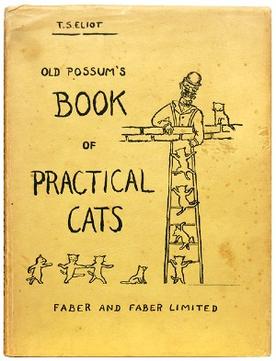
Practical Cats is a short volume (fewer than 50 pages), but that's typical of poetry collections. Unlike his more weighty poems, such as "Prufrock," "The Waste Lands," or "The Hollow Men," this is light verse, originally penned to amuse his godchildren. (Though perhaps the occasional classical allusion slips in—I wonder whether "The Naming of Cats," which reveals that cats have three different names, a common one, a dignified one, and a secret one, parodies the trinomen given to citizens of ancient Rome.)

Eliot does a wonderful job describing the personalities of cats, including their laziness (Jennyanydots, "The Old Gumbie Cat"), pickiness ("The Rum Tum Tugger"), and thievishness ("Mungojerrie and Rumpelteazer" and "Macavity: the Mystery Cat"). Other highlights include "Mr. Mistoffelees," who can do magic tricks; "Skimbleshanks: the Railway Cat," without whom the mail trains couldn't operate; and "The Pekes and the Pollicles," about a ruckus caused by rival dog factions. But you didn't pick this book up to read about a bunch of stupid dogs.

Famously, Old Possum's Book of Practical Cats is where British rock band Mungo Jerry got their name. It's too bad Mungo Jerry never set the poems to music. Someone really should. In the meantime, if you like light verse and cats, give it a read sometime.

January 18, 2020

How climate change answers everything

First off, let me say I have no opinion on the USMCA. I'm not an economist, so I don't know if ultimately it would turn out to be a good or a bad thing. I'll wait and see. That said, this article makes a great springboard for my own point:

Senate Minority Leader Charles Schumer (D-N.Y.) and other Democrats announced Thursday they would not support the U.S.-Mexico-Canada Agreement (USMCA), citing the proposed deal's failure to address climate change.

"Despite the fact that it includes very good labor provisions, I am voting against USMCA because it does not address climate change, the greatest threat facing the planet," Schumer said in a statement.

[Full Story]

I like this approach. I like it so much, in fact, that I think the right should adopt it forthwith, and use it against any progressive objectives deemed ridiculous by the common-sense-based community. For example:

  • Do you want to legalize more and later-term abortions? Or impose bubble zones around abortion clinics where free-speech rights do not exist? "I'm sorry, but your bill does not address climate change. I vote no."
  • Do you think people ought to be subject to fines if they "misgender" or "deadname" transgender and so-called "non-binary" people, or refuse to use silly, made-up pronuns like "xir"? "Despite the fact that it includes good provisions, this legislation does not address climate change, the greatest threat facing the planet. I vote no."
  • Perhaps you think we should legalize marijuana. "We have only ten years to save the planet from Climate Armageddon, and you want to increase carbon emissions by making it legal to set more stuff on fire? I vote no."

As far as I can tell, this approach has multiple positive effects: It uses the hysterical left's own tactics against them. It highlights the absurdity of both their social agenda and their climate hysteria. And who knows? Maybe something might actually (albeit accidentally) get done to reduce greenhouse gases and other pollution.

December 31, 2019

2019 in books

2019 ended for me pretty much as it began: reading airport thrillers on a Greyhound. I started the year with a Jack Reacher novel between Sudbury and Ottawa. I (almost) ended it on the way back reading The Institute by Stephen King. In between (and shortly after), I read 33 other books in 2019. While this falls short of my intended annual goal of 50 books, I managed to read a lot more titles than in previous years since I started tracking my reading. Usually I manage somewhere in the mid-20s.

(I think, in fact, The Institute is the only thing I read this past year that was actually published in 2019, which is kind of ironic for a post titled "2019 in Books.")

Here are some of the highlights of my reading pursuits.

December 18, 2019

And now . . . this - Dec. 18/19

An exotic-looking bright orange bird was rescued by a wildlife hospital after people saw him on the side of a highway. . . .

According to the hospital in Buckinghamshire, UK, the bird had somehow doused himself in curry or turmeric, which prevented him from flying properly.

[Full Story]

I love curry. I read books like Daniel Santiagoe's Victorian classic, The Curry Cook's Assistant, as well as Madhur Jaffrey's cookbooks, for entertainment. So I realize you can curry pretty much anything. This, however, is pushing the envelope.

November 09, 2019

I know we'll meet again some sunny day

A lightning review of The Storm of War by Andrew Roberts (New York: HarperCollins, 2011).

I first heard of Andrew Roberts and The Storm of War back around 2011, when the book was new and theologian Albert Mohler interviewed him for his podcast, Thinking in Public, in which he called The Storm of War "the finest one-volume history of World War II I've ever read." I borrowed the public library's copy, which for some reason was hard to find in the stacks; it took a few weeks for the library to locate it and put it on hold for me. Unfortunately, at the time I was only able to read the first few chapters, but it was enough to whet my appetite, and I finally committed to reading it cover-to-cover for this year's Science Fiction-Free September.

Unfortunately, in the intervening eight years, the library had (again?) lost or discarded its copy. I know Roberts is a reputed and popular historian, but I wouldn't have thought he was steal-this-book popular. Fortunately, I was able to obtain another before September was over. Little did I know it would take me the rest of September, all of October, and the first week of November to finish it—and at a shade over 700 pages, it's long, but not that long. Chalk it up to relatively little contiguous free time for committed reading. (I do miss those hour-long rides to work on the bus.)

The Storm of War is, I would say, semi-chronological in its arrangement: each chapter covers a major campaign or facet of the war: the Battle of Britain, the Holocaust, the battle in the Pacific, and so forth, in rough chronological order. Not being an avid reader of history books, I don't know if this is the norm or just Roberts' particular method of presentation. To an extent, it made the book feel a little bit non-linear. But with a topic as extensive as WWII, could it have been done any other way?

The central character of the book is, not surprisingly, Adolf Hitler. Roberts portrays his handling of the war as that of an inept dilettante. Amongst "Corporal Hitler's" major blunders were halting the advance on Dunkirk (thus allowing the British Expeditionary Force to evacuate), launching Operation Barbarossa against Russia (and underestimating the ferocity with which the Russians would defend the Motherland), declaring war against the United States following Pearl Harbor, and remaining committed to a "stand or die" policy that prevented his generals from making strategic retreats. Of course, had Hitler not been a doctrinaire National Socialist, he may not have started World War II at all—but, then again, maybe he would have won it. It was his commitment to Nazi ideology that was responsible for many of his blunders.

All in all, though, an engaging read, even if it did take up more of my time than I anticipated. I'd read Roberts again: his recent biography of Churchill, Churchill: Walking with Destiny, looks interesting.